Different mechanisms are addressed — and they do not conflict with one another. In Phase I human trials, it was determined that MOTS-c is well-tolerated at therapeutic doses. While there is more human trial data available for NAD+, MOTS-c exhibits a more targeted metabolic action.
At 3 doses per week (add one vial), two more swabs, and one more syringe per week to the totals above. Add one vial per week if planning 3 doses per week instead. SuppliesPer dose you need one vial (shared across two doses) — one syringe, two alcohol swabs, and a small amount of bacteriostatic water. On non-training days within a dosing week — MOTS-c is usually still taken in the morning to preserve routine and keep dosing intervals even. Avoid leaving vials at room temperature for extended periods, and do not freeze reconstituted solution unless specifically directed by the pharmacy.
The peptide promotes glucose uptake into skeletal muscle independently of insulin signaling, providing an alternative pathway for blood sugar management. This mitochondrial peptide operates through mechanisms distinct from most other research peptides, informing dosing considerations. They target mitochondria through completely different mechanisms. Refrigerated storage (used within 28 days), is the documented approach. Protocols describe adding 2 mL of bacteriostatic water to a 10 mg vial. In those protocols, a 10 mg vial reconstituted with 2 mL BAC water yields 5 mg/mL; a 1 mg dose corresponds to 20 units on an insulin syringe.
Top MOTS-C Vendors

Endurance becomes noticeable in training — especially during longer cardio or higher-rep sets. Some users report nothing for the first 10 to 14 days, and that silence is normal. If a photo set shows more without a calorie deficit and training plan, something else is driving the result. They involve concurrent diet changes, training, and often other peptides stacked simultaneously.
Research suggests that MOTS-C may aid in weight management, longevity, glucose metabolism, and exercise performance. 70% isopropyl alcohol prep pads, individually wrapped, for cleaning the vial stopper and injection site before MOTS-c dosing. BD Ultra-Fine 31G 0.3cc insulin syringes — each gradation marks 1 unit, for accurate sub-50-unit MOTS-c doses. Both target mitochondrial function but through different mechanisms. Studies demonstrate effects on insulin resistance (obesity), exercise capacity, inflammation, and aging in animal models.
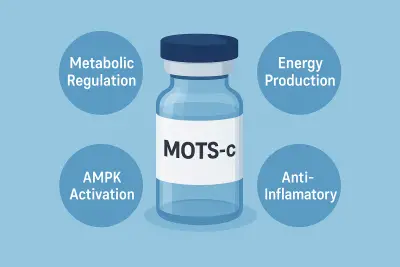
For long-term use , 6 months or longer,, it’s recommended to administer anywhere from 5 to 20mg of MOTS-C every five days. PeptidePrescript offers a curated selection of such compounds — each prepared under strict pharmacy standards. Higher doses up to 10–15 mg/week are used for active insulin resistance under physician supervision. After the discovery of humanin (HN) in 2001, researchers went on in 2015 to identify another new mitochondrial derived peptide (MDP) known as MOTS-c . One of the most studied mechanisms of MOTS-c is its interaction with AMPK, a key energy-sensing pathway.
Anyone considering peptides in a fitness context should MOTS-c peptide supplier first consult a healthcare professional and review our discussion of peptide stacking for a balanced view of combining compounds. In humans (acute bouts of exercise have been shown to raise MOTS-c levels in plasma and skeletal muscle), particularly in younger, metabolically healthy individuals. These findings led some scientists to describe MOTS-c as a potential exercise-mimetic — a molecule that reproduces certain adaptive responses to training. Readers interested in the broader landscape of aging-related peptides may also want to review our guide to CJC-1295 and other growth-related compounds, which are sometimes discussed alongside MOTS-c in longevity contexts. Because MOTS-c is a mitochondrial signal that boosts stress-adaptive gene expression, it is studied as a potential way to support mitochondrial resilience during aging.

Those with metabolic dysfunction represent primary candidates for MOTS-c based on its core mechanisms. HOMA-IR calculations from glucose and insulin quantify insulin resistance. Spacing doses by 1-2 hours ensures distinct absorption and signaling phases. Those already using metformin for metabolic conditions should coordinate MOTS-c use with healthcare providers. Several peptide categories combine logically with MOTS-c based on complementary mechanisms.
Twenty participants with obesity and at least 10% liver fat received either 25mg CB4211 via daily subcutaneous injection or placebo for 28 days. CB4211 (a MOTS-c analog developed by CohBar), represents the most advanced clinical testing of MOTS-c related compounds. If certain doses produce problems while others do not — you can find your optimal range.
Key takeaways
When you take MOTS-c matters for both efficacy and side effect profile. Here is how experienced researchers minimize adverse reactions while maintaining effective dosing. TB-500 similarly works through distinct mechanisms. Stacking MOTS-c with other peptides requires understanding how their mechanisms interact. Both can affect muscle tissue through different mechanisms — and combined effects might amplify issues.
➤ Encourages the reduction of fat while preserving muscle mass.
Persistent fatigue, nausea, and fluctuations in blood sugar are experienced by the other, lasting for several days. Evaluating your own risk profile greatly depends on understanding this context. Researchers can navigate these types of questions with the assistance of SeekPeptides. This practical knowledge distinguishes informed researchers from those lacking insight. Common causes are addressed by ensuring appropriate subcutaneous depth, selecting the right needle gauge, and allowing the alcohol prep to dry prior to injection.
Your results with MOTS-c before and after are significantly influenced by your baseline metabolic health, diet, and training regimen. Insulin sensitivity is enhanced by MOTS-c through the improvement of GLUT4 transporter activity in skeletal muscle. This pathway, activated by exercise and the diabetes medication metformin, contributes to the comparisons made between MOTS-c and both. By activating AMPK, the peptide enhances mitochondrial function, improves glucose uptake, and requires consistent training and nutrition to yield significant results.
Typical dosing for MOTS-C is 10 mg administered subcutaneously once a week over a four-week period. The capacity of MOTS-C to enhance metabolic efficiency has generated interest in sports and physical training — potentially aiding athletes in more effective energy utilization. Researchers at the University of Southern California identified MOTS-C in 2012.
Cleaning vial stoppers and injection sites prior to subcutaneous dosing is the standard practice. The 0.3cc 31G syringes have 1 unit marked for each gradation , as opposed to 2 units on a 1cc,, ensuring accuracy for peptide doses under 50 units. The most frequently mentioned dedicated peptide-storage refrigerator in research communities holds approximately 20 vials and operates quietly.